Across the country, schools, districts, state agencies, workforce organizations, and nonprofit partners collect more information than ever about student experiences and outcomes. Yet too often, data gets used primarily for reporting, compliance, or accountability. Dashboards can highlight gaps or trends, but, alone, they don’t reveal what’s driving those results or what leaders should do next.
TNTP’s new publication, From Data to Action: A Practical Approach to Continuous Improvement, explores a different approach. Drawing on TNTP’s work with state and local partners across different contexts, the publication shows how organizations can move beyond reviewing data to using it as a tool for inquiry, action, and improvement.
Why Access to Data Isn’t Enough to Drive Change
At the center of the publication is a simple idea: meaningful change starts with meaningful questions. Rather than searching for more data, educators and leaders can use the information they already have to identify priorities, better understand root causes, test practical solutions, and learn from the results over time. TNTP’s approach encourages teams to:
- ask focused questions to connect broad goals with specific patterns,
- take the time to evaluate evidence together,
- engage the people closest to the challenge to explore root causes, and
- use evidence to guide action and generate learning that improves student outcomes.
This approach helps organizations focus less on collecting more information and more on using the data they already have at their fingertips to make better decisions.
Driving Better Decision-Making
The publication highlights case studies from TNTP’s work in Arkansas, Tennessee, and Nebraska that illustrate how different state and district leaders used a structured process for continuous improvement to tackle local challenges, ranging from career pathway access to chronic absenteeism. With support from the Gates Foundation, TNTP used the same four-phase process from Mathematica’s Education-to-Workforce (E-W) Indicator Framework in different contexts.
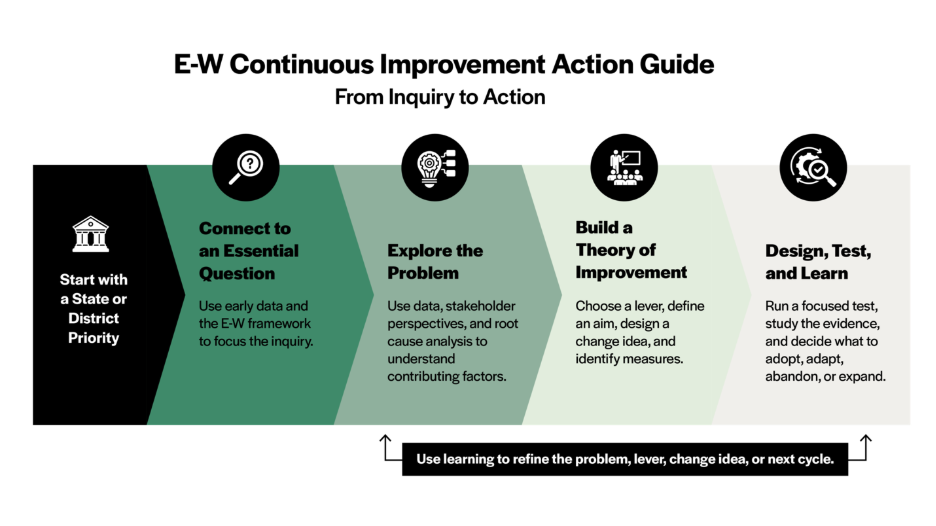
Rather than searching for one-time solutions, teams identified barriers, tested practical improvements, and used continuous learning to strengthen student outcomes, whether by improving alignment between math instruction and CTE programs, expanding families’ awareness of workforce opportunities, or helping more students stay engaged in school.
While the challenge differed across districts, the process was the same: use data to understand the problem more deeply, identify actionable opportunities, and learn from implementation over time.
Education systems, workforce organizations, and even state governments don’t always need more information. Often, they need a practical process for converting information into action. Read our latest publication, From Data to Action: A Practical Approach to Continuous Improvement to learn more.