
Case Study
How TNTP Helped Schools Build Stronger Career and Technical Education Pathways in Arkansas and Tennessee
Quality career training leads to meaningful employment opportunities with a living wage and growth potential. Yet career and technical education (CTE) programs are frequently misaligned with projected job openings in local regions. In addition, many students lack information on quality jobs in the region, or lack the skills they need for employment.
With the support of the Gates Foundation, TNTP partnered with education leaders in Arkansas and Tennessee to understand the gap in Math skills necessary for jobs in the local economy, reflect on barriers, and pilot local interventions.
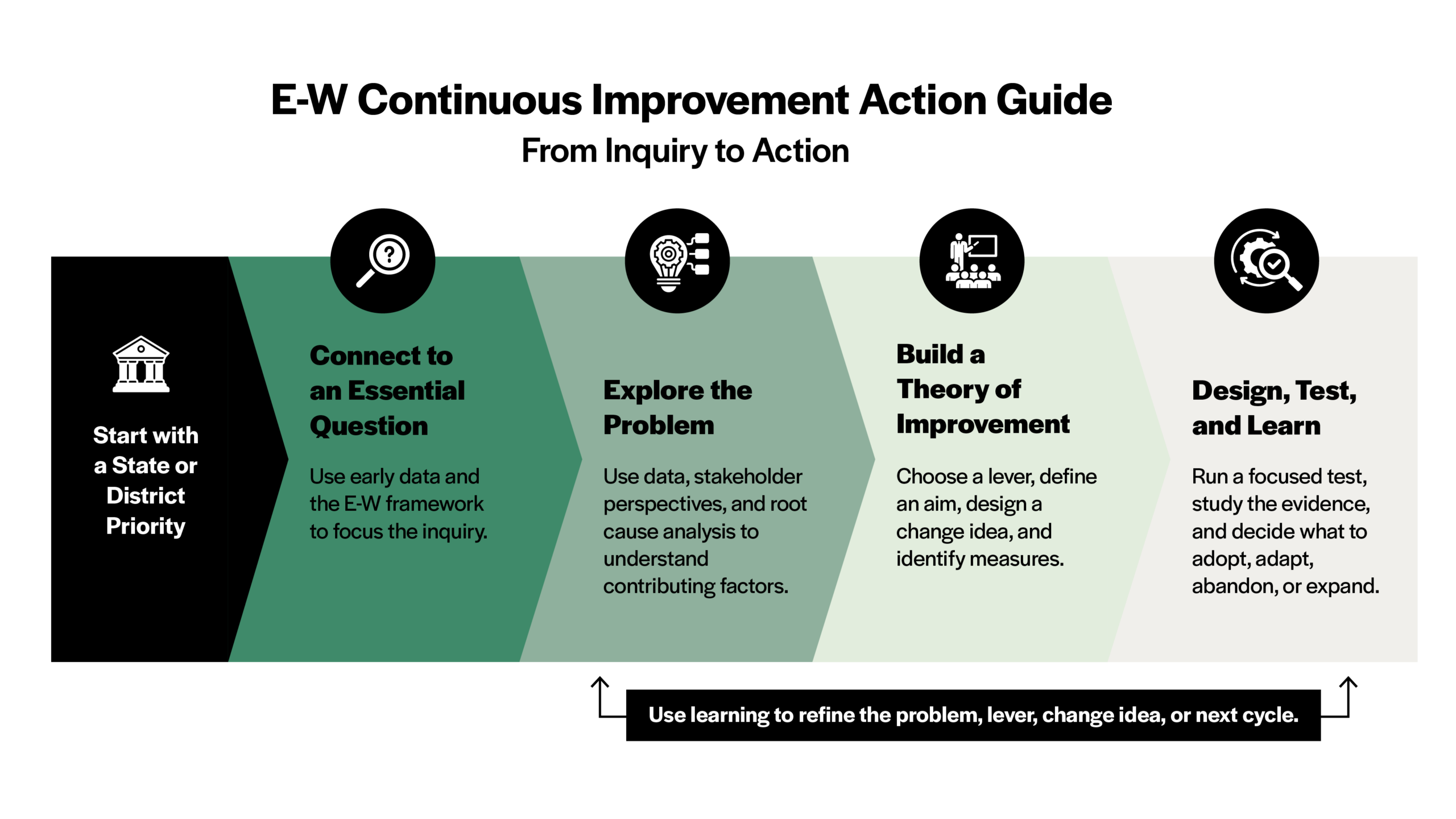
What Is the Education-to-Workforce Framework?
What’s the best way to improve career and technical education programs? It can be hard for educators to engage with such a broad question. There are lots of factors to consider, many beyond the direct control of school systems. For example:
- How do we define a “quality job”?
- How well do our CTE programs prepare students now?
- What skills will employers need in the future?
The Education-to-Workforce (E-W) Indicator Framework helps educators pick a place to start. It connects what happens in the classroom to long-term outcomes—like employment and earnings—so educators can better understand their impact beyond graduation.
The Framework includes essential questions, which ground the discussion in the big picture, and indicators, which drill down into practical interventions and measure success.
Essential Questions: Questions every data system should be able to answer
E.g. Are there quality pathways for students who pursue career training that lead to employment in quality jobs?
Indicators: Indicators of student outcomes and milestones, from early childhood to career
E.g. Career and technical education pathway offerings are aligned to in-demand occupations, as defined by regional labor market data.
Using the E-W Framework, TNTP and state leaders analyzed data to define key challenges, then worked with select districts to brainstorm and implement practical solutions.
What Arkansas’ and Tennessee’s Data Revealed
TNTP worked with state leaders in Arkansas and Tennessee to explore this essential question:
Essential Question 15: Are there quality pathways for students who pursue career training that lead to employment in quality jobs?
In a typical conversation about CTE, it’s easy to make assumptions about why students aren’t moving on to quality jobs: Perhaps the programs are outdated, or employers are not involved enough, or perhaps there simply isn’t enough data to know what jobs graduates hold. In this situation, leaders may either do nothing (“I’m not empowered to act”) or make a major new bet (like designing a new CTE pathway) without knowing how it will work.
Starting with a bigger essential question prompted a more intentional conversation. It pushed participants to look at a focused set of data and explore solutions in their locus of control. These essential questions also promote cross-sector engagement, workforce needs, and program development.
In initial conversations, state leaders in both Arkansas and Tennessee identified CTE and Math as state priorities, so TNTP brought together state experts in Math and CTE to review key data and identify a focus for the work. They reviewed state data—including math performance by district and grade level, CTE Perkins performance reports, and local industry data about in-demand careers—to define a problem statement and focus industry.
Discussion questions included the following:
- What are the main industries in different regions of the state? Where do we anticipate growth?
- How many individuals are employed in a “quality job,” and how is that defined (for example, in terms of wages, benefits, and career advancement opportunities)?
- How many individuals have access to jobs paying a living wage?
- How many students meet grade-level standards in math, as measured by state standardized tests?
This data review helped state leaders choose districts and regions where the work could both meet student needs and the growing demand for skilled workers in local industries.
In Arkansas, growth industries include agriculture, animal sciences, and lithium. In Southwest Arkansas, in particular, new lithium plants are expected to open by 2028. The plants will create quality jobs—but leaders are concerned that too many students lack the math skills for these roles.
In Tennessee, growth industries include agriculture, healthcare, and nuclear energy. Leaders decided to focus on agriculture, which makes up a significant share of the economy in rural areas. It’s an emerging technology space—not just “plows and cows”—and requires strong math skills.
Problem Statement
Using the essential question as a guide, leaders were able to zoom in on one growth industry and one particular barrier for students. As a result of this discussion, leaders in both Arkansas and Tennessee both identified a narrower problem statement to guide TNTP’s work with districts:
Too many students lack the necessary math skills for high-wage, high-demand careers in the region.
How Districts Turned Data into Action
State leaders recommended a set of potential districts that could opt-in for direct support on this problem statement. These small, rural districts serve between 400-1,200 students, the majority of whom score below the state average on math tests. TNTP gathered each district team in person to review existing data (such as the Arkansas CTE data dashboard), refine the problem statement, examine root causes, and establish a concrete change idea.
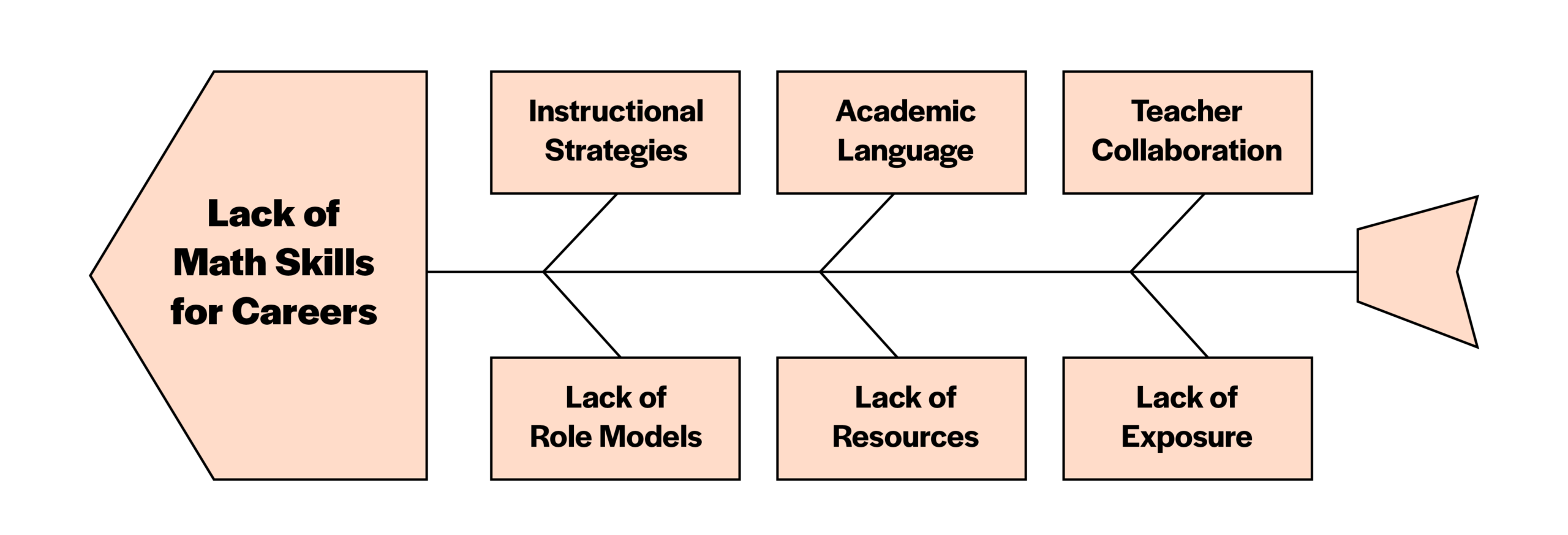
Participants did a fishbone analysis, a tool for uncovering the root causes of a problem. By organizing causes into categories, participants are encouraged to think beyond their first instinct. For example, instead of stopping at curriculum gaps, they must also consider student belief in their own abilities (Self-Efficacy), exposure to career opportunities (Access to Career Advising), and student-teacher interactions (Student Perceptions of Teaching).
100% of participants said the fishbone analysis helped them identify a concrete action.
The process lets participants think broadly about the issue, move past the obvious answers, and identify actions that are within their control. In surveys after the session, 92% of participants said they were likely to use this process in their district or region. All respondents agreed that the fishbone exercise, in particular, helped their group better understand the challenges, and identify at least one concrete action.
Figure 1: Sample Fishbone Analysis
Arkansas
Three rural districts in southwest Arkansas chose to participate: Blevins, Fouke, and Nevada. With the support of staff from the Southwest Arkansas Education Cooperative (a regional service center that supports a set of local districts) the partner districts focused on five key E-W Indicators that address the problem statement.
Key Indicators:
- Access to In-Demand CTE Pathways (priority)
- CTE Pathway Concentrations
- Math Proficiency in High School
- Postsecondary Enrollment Directly After High School Graduation
- Successful Career Transition After High School
Using the indicator guidance, the district teams used the Arkansas CTE data dashboard to identify the most relevant data to guide their efforts, including high school math proficiency as measured by state assessments, dual enrollment statistics (early college coursework completion), high school graduation rates, and career readiness assessments, which measures essential work skills (including applied math).
Each district then used the process described above to define a problem statement specific to their district and identify concrete intervention to put into action. In other words, why do students lack the math skills for high-wage, high-demand careers, and what can we do about it?
Blevins School District
Problem statement: Not enough intentional connections are being made between core Math courses and CTE courses/pathways by students and staff.
Intervention: The Blevins team decided to increase collaboration between math and CTE teachers. They tried to set up shared planning time, but struggled with timing and capacity. However, the opportunity to begin conversations with the Math team prompted informal efforts across the CTE team to integrate more explicit Math vocabulary into their lessons, and begin to explore opportunities to use their own lessons to guide students to explain their thinking, a critical skill that the Math team was working to address in their own lessons.
The CTE team pivoted to understanding the overlap in math and CTE standards. Inspired by a Math-in-CTE curriculum integration, CTE teachers began to explore more intentional ways to make connections with the math standards in the CTE classes.
In the spring, Blevins leadership brought math and CTE teachers together to identify connections and gaps across the two sets of standards. The teams reviewed state testing data together to explore core priorities for students. Over the summer, the team held planning days for the Math and CTE teams to co-plan around these key priorities.
Fouke School District
Problem statement: There are gaps in stakeholders’ understanding of how math skills in the math classroom translate into the CTE classroom and vice versa.
Intervention: As in Blevins, the Fouke team also decided to increase coordination between the math and CTE teachers. The team initially planned to create protected time for CTE teachers and math teachers to co-plan. However, finding meeting time proved challenging, so teachers looked for other ways to build connections between math and CTE. In early analysis across the standards, the leadership team uncovered a critical math skill that was necessary for the CTE class that students had not yet learned due to course sequences. This discovery prompted continued reflection around how to create systems to support students and teachers to make the connections across skills and standards.
The CTE teachers began exploring evidence-based practices that connected math and CTE concepts. For example, the computer science teacher found a free syllabus that uses coding to reinforce and extend students’ understanding of mathematics. As students learn major programming concepts (e.g. using Python code to “draw” a door), they will develop math-related projects (e.g. calculating the area and perimeter of that door.)
Looking ahead, the team aims to cross-walk key math and CTE vocabulary, and use this shared vocabulary in both classrooms. For example, a CTE lesson on building a stairway might use terms like “risers” and “treads,” while math classes refer to “slope” and “angles.” A shared vocabulary helps students connect the concepts and see how math applies in real life.
Nevada School District
Problem statement: There are gaps in student/family understanding of the breadth of postsecondary opportunities in the region, and how those opportunities connect to CTE programs.
Intervention: The Nevada team decided to create multiple engagement events to introduce students to an array of career opportunities, starting with a flagship career fair. They would prepare students for the career fair in advance, and engage community members to contribute.
The Nevada team scheduled a career fair for February, surveyed students about their interests, and engaged local employers and community members. Unfortunately, the fair was cancelled by an ice storm, but the conversation still created a new sense of possibility for Nevada teachers.
In the spring, they reached out to Nevada alumni and asked them to record short videos about their careers to share with current students. To date, they have gathered 16 short videos of past graduates talking about their education-to-career journey. The team plans to make these available to students by showing them during class and posting them on social media.
A member of the Nevada team reflected, “This process opened up space to think about what was in our locus of control.”
Scaling to Cooperatives
This process proved so productive at the district level that TNTP scaled the process for planning across the Arkansas Cooperatives, regional service centers that support groups of districts. CTE and Math Leads worked together to review Math performance data alongside CTE Pathway data and workforce data, finding connections and gaps across the datasets and student experiences. Leaders worked together to engage in root cause analyses and define key opportunities for improvement in their region.
Tennessee
State leaders recommended working with the state-run Alvin C. York Agricultural Institute, a single-school district in rural Tennessee with around 470 students, 400 acres of land and a working farm. It is the only comprehensive secondary school that is financed and operated by a state government.
Alvin C. York (York) Agricultural Institute
Problem statement: Many students and their families aren’t aware of how York Institute programs of study connect directly to real world career and post-secondary opportunities.
Intervention: The York team decided to increase students’ exposure to high-tech jobs in agriculture, such as animal nutritionist, agronomist, agricultural engineer, or soil scientist. They wanted to help students see that many of the quality jobs in agriculture that connect to the available pathways require strong math and science skills.
To start, they paired teachers from a CTE pathway with teachers from a related core subject (e.g., math and agriculture) to create posters about available career paths. The teachers engaged more than 50 local businesses to display the posters and are using QR codes to track engagement. The team gathered baseline data around career understanding among students in grades 9-12, and will repeat the survey in spring to assess growth and inform career advising.
The York team has also launched several other efforts connected to career exploration and advising for their students (Access to College and Career Advising). Each year, York hosts incoming students in eighth grade to learn about the different programs and pathways, a day that has traditionally focused on administrative details.
This year, the York team hosted a full day event, allowing prospective students to experience different CTE classrooms and programs, connect with current students, and tour the farm. Several students asked to make shifts in their schedules once they better understood the components of the agriculture program. Several female students also expressed interest in the construction and welding programs after seeing current female students in those classrooms (an example of the Self-Efficacy indicator).
Looking ahead, the team has designed a career exploration class to give all current ninth graders the opportunity to better understand the programs, the connection to academic content, and the array of career-connected opportunities.
From a Broad Question to Promising Pilots
Using the Education-to-Workforce framework helped shift the conversation around career readiness and identify new data of interest that might be affecting student pathways. Educators in Arkansas and Tennessee found it extremely valuable to brainstorm with colleagues. Instead of getting overwhelmed by the big picture, educators defined a narrower problem, looked at existing data through a new lens, reviewed and discussed evidence-based practices to prompt ideas, and identified realistic actions to improve career preparation for students. Starting small helped build a critical sense of agency for educators, created a culture of action, and generated promising practices with the potential to scale.
Stay in the Know
Sign up for updates on our latest research, insights, and high-impact work.
"*" indicates required fields

Policy Pulse Check: State Laws Passed in 2026—and What They’ll Mean for Students
Learn what states prioritized in 2026 legislative sessions, how new laws may impact students, and what districts need to implement new policies.

How to Strengthen Your CTE Program Without Hiring New Teachers
Here are three ways districts can expand their CTE programs to improve career opportunities for students without finding and certifying new teachers.

Beyond Opportunity
TNTP embraces the challenge of this decade: to build an infrastructure for human capability so every young person can navigate pathways to opportunity.

Designing Career-Connected Learning That Starts Early and Builds for Life: Highlights from the Field
Explore how schools are reimagining career-connected learning—from early exposure to high school immersion—to equip students for the future.

Most Career Pathway Programs Aren’t Preparing Students for Good Jobs. Here’s How States Can Change That.
Students deserve career pathways that lead to success. ROI studies give states the data to align programs with high-wage, high-demand careers.

A teacher leads a one-on-one reading session focused on strategy and engagement.
About TNTP
TNTP is the nation’s leading research, policy, and consulting organization dedicated to transforming America’s public education system so that every young person thrives.
Today, we work side-by-side with educators, system leaders, and communities across the nation to reach ambitious goals for student success.
Yet the possibilities we imagine push far beyond the walls of school and the education field alone. We are catalyzing a movement across sectors to create multiple pathways for young people to achieve academic, economic, and social mobility.