
Case Study
How TNTP Helped Nebraska Schools Reduce Chronic Absenteeism
In the 2024-25 school year, 21 percent of Nebraska’s students were chronically absent, up from 15 percent in 2020. Those 65,000 students are less likely to read and do math at grade level, graduate on time, or earn a good living. The Commissioner of Education has set a goal of cutting the current absenteeism rate in half by 2030.
With the support of the Gates Foundation, TNTP partnered with the Nebraska Department of Education (NDE) and the Nebraska Statewide Workforce & Educational Reporting System (NSWERS), a state-of-the-art data system that integrates education and workforce data from preschool to grade 12, through college, and into work, creating a holistic view of the learning and earning journey. This unique longitudinal data set provided the foundation for leaders to understand chronic absenteeism, reflect on root causes, and pilot local interventions.
What is the Education-to-Workforce Framework?
What’s the best way to address chronic absenteeism, defined as missing 10 percent or more of school days in a year? Discussions often center on compliance, and educators can get hung up on details about coding days and types of absences. Is missing 10 days of school that different from 9? Should missing school for a sports game count the same as missing school for an illness?
With a narrow focus on technical details, it’s easy for educators to miss the bigger picture: Why consistent attendance matters and how schools can encourage it.
The Education-to-Workforce (E-W) Indicator Framework helps educators put chronic absenteeism in a broader context. It connects what happens in the classroom to long-term outcomes—like employment and earnings—so educators can better understand the impact beyond graduation.
The E-W Framework includes essential questions, which ground the discussion in the big picture, and indicators, which drill down into practical interventions and measure success.
Essential Questions: Questions every data system should be able to answer
E.g. Are students demonstrating satisfactory academic progress, consistent attendance, and positive behavior to be considered on track for high school graduation?
Indicators: Indicators of student outcomes and milestones, from early childhood to career
E.g. Students are present for more than 90 percent of enrolled days.
Using the E-W framework, TNTP and state leaders analyzed data to define key attendance challenges, then worked with select districts to brainstorm and implement practical solutions. The E-W Framework served as an organizing tool to guide educators through an improvement process and helped them make informed decisions.
What Nebraska’s Data Revealed
TNTP worked with state leaders to explore this essential question and indicator:
Essential Question 11: Are students demonstrating satisfactory academic progress, consistent attendance, and positive behavior to be considered on track for high school graduation?
Key Indicator: Students are present for more than 90 percent of enrolled days.
This essential question looks at attendance alongside academic progress and positive behavior, offering a more holistic view. It shifts the conversation from the mechanics of tracking absences to the implications of those absences for student success.
For example, two students on the same sports team might both miss school for an away game. One student, who is on track academically, might make up the work easily. Another student might struggle to catch up. The goal is to understand the full picture of student progress.
With this broader lens, the Nebraska team reviewed a coherent set of attendance data from NSWERS, which is informed by the E-W Indicator Framework. In 2025, the NSWERS team published a research brief about the state of chronic absenteeism in Nebraska and its impacts.
The data is clear: chronic absenteeism begins in kindergarten and starts increasing significantly in sixth grade. The problem is most pronounced in high school, when many students miss more than 30 school days a year–more than triple the recommended maximum.

However, the state data alone isn’t enough to create change. So state leaders invited a set of districts to dig into the issue with TNTP and identify local solutions.
How Districts Turned Attendance Data Into Action
State leaders recommended a set of potential districts that could opt-in for direct support on this problem statement. These districts didn’t have the highest absenteeism rates in the state—those with acute absenteeism issues already had other support—but they had room for improvement.
TNTP gathered each district team virtually to review existing data, refine the problem statement, examine root causes, and establish a concrete change idea. The NSWERS team produced district-specific versions of the absenteeism reports for teams to review trends in their districts. Teams were surprised by the fluctuations by grade, and noted specific transition years where students were particularly vulnerable to absenteeism.
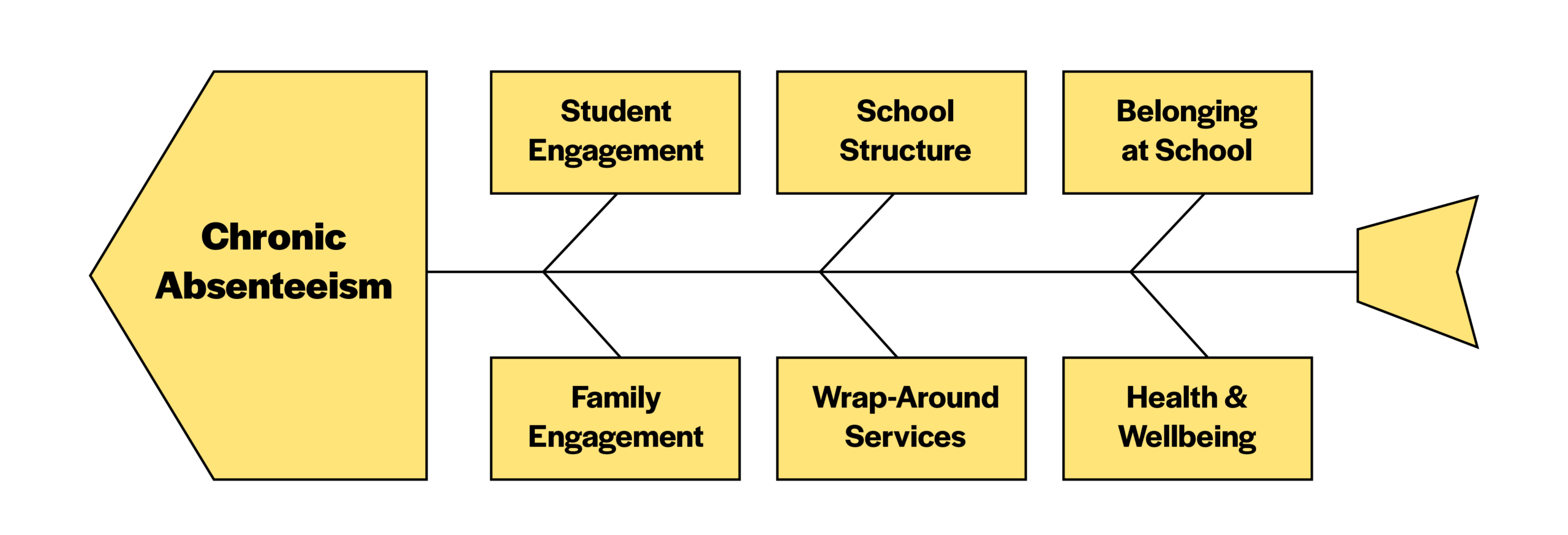
Then participants did a fishbone analysis, a tool for uncovering the root causes of a problem. It looks like a fish skeleton: the “head” is the problem, and the “bones” represent categories of possible causes (Figure 1). By organizing causes into categories, participants are encouraged to think beyond their first instinct. For example, instead of stopping at student health and transportation issues, they must also consider how engaged students are at school.
The process lets participants think broadly about the issue, move past the obvious answers, and identify actions that are within their control. In surveys after the session, 100% of participants said they were likely to use this process in their district or region and agreed that the fishbone exercise, in particular, helped their group identify at least one concrete action.
Figure 1: Sample Fishbone Analysis
Gering School District
Problem statement: Too many students are chronically absent in key transition grades, including fourth, eighth, and ninth grades.
Intervention: The Gering team decided to invest in student engagement in grades 4, 8, and 9 over the course of the 2026-27 school year. To pilot this approach in the spring of 2026, the team reviewed weekly attendance reports to identify students most at risk of becoming chronically absent in the three selected grades, and paired each with a trusted adult who would make regular personal connections with the student.
“We knew we had students that were chronically absent and here we were doing the same thing over and over,” explains a school leader. “I think being able to see the absence data broken down really shifted our lens to be on the impact it makes on what we’re trying to do every day.
To date, middle and high school counselors met at least weekly with the identified students. The middle school also surveyed students each semester to ask, among other things, whether the student is connected with at least one adult. Gering plans to scale this approach at the middle school and high school in the 2026-27 school year.
“We knew absenteeism was a problem, but we hadn’t placed the focus on it that we needed to because, at the end of the day, if a child is not in the seat, they aren’t learning,” explains a school leader. “We knew as a group it was a problem and it’s only going to trend in one direction unless we focus more on it.”
York School District
Problem statement: Too many students are chronically absent in fifth, eighth, and eleventh grades.
Intervention: The York team decided to invest in parent and family partnerships, especially educating parents on the connection between attendance and academic achievement and long-term outcomes. They aligned on key messages and then updated existing communications (attendance letters, newsletters), used staff time for targeted outreach, raised awareness in the community, and defined roles and responsibilities.
For example, at an event for incoming kindergarteners, leaders showed parents the state attendance data. They stressed that absenteeism starts in kindergarten, builds by grade, and can have long-term effects on overall education and wellbeing. The shift from a short-term compliance focus to the bigger picture of student success was a way to invest parents in consistent attendance from the very beginning.
A school leader explained that a key shift in the team’s discussion was “involving parents as a collaborative team member as opposed to notification of a ‘reprimand’ or other consequence.”
“This work has really shifted us to truly be proactive with chronic absenteeism,” a leader explained, “We’re putting the data in front of parents about what it means and how that affects academic achievement. We know it has been effective because people are talking about it in our community.”
From Tracking Absences to Building a Culture of Attendance
Using the Education-to-Workforce framework helped shift the conversation around chronic absenteeism. Through this process, educators pulled up from the weeds of tracking absences to consider how attendance contributes to student success. By engaging students and families, educators are building a collective sense of responsibility for making sure kids come to school.
Stay in the Know
Sign up for updates on our latest research, insights, and high-impact work.
"*" indicates required fields

Policy Pulse Check: State Laws Passed in 2026—and What They’ll Mean for Students
Learn what states prioritized in 2026 legislative sessions, how new laws may impact students, and what districts need to implement new policies.

How to Strengthen Your CTE Program Without Hiring New Teachers
Here are three ways districts can expand their CTE programs to improve career opportunities for students without finding and certifying new teachers.

From Coherence to Careers: How States Can Better Support Today’s Students
This roadmap identifies three priorities for state policymakers in education: coherence across K-12 systems, education-to-career strategies, and responsible use of AI.

Strengthening Educator Preparation for High-Quality Literacy Instruction in Tennessee
TNTP supports Tennessee educator prep programs (EPPs) to align training to national best practices so all students receive high-quality literacy instruction.

Designing Career-Connected Learning That Starts Early and Builds for Life: Highlights from the Field
Explore how schools are reimagining career-connected learning—from early exposure to high school immersion—to equip students for the future.

A teacher leads a one-on-one reading session focused on strategy and engagement.
About TNTP
TNTP is the nation’s leading research, policy, and consulting organization dedicated to transforming America’s public education system so that every young person thrives.
Today, we work side-by-side with educators, system leaders, and communities across the nation to reach ambitious goals for student success.
Yet the possibilities we imagine push far beyond the walls of school and the education field alone. We are catalyzing a movement across sectors to create multiple pathways for young people to achieve academic, economic, and social mobility.