

A fourth-grade teacher–we’ll call her Jenny–walks into a conference room with seven or eight rectangular tables and windows overlooking State Highway 71 in Austin, Texas. She’s attending her first day at Austin Independent School District’s (Austin ISD) Bilingual Academy.
Jenny has been teaching in the Austin ISD for three years, and she loves her school, students, and families. But now, her position is at risk.
Recent state policy requires districts to reduce the number of uncertified teachers serving emergent bilingual students. Jenny understands why. She knows that certified teachers lead to stronger outcomes for students, especially multilingual learners and those furthest from opportunity.
The problem is that she has already taken the certification exam twice without passing.
Like many people, Jenny struggles with test anxiety. She learned English as a second language herself, and despite being a strong classroom teacher, the certification process has felt isolating and overwhelming.
Jenny’s story is not unique. Across Austin ISD, other talented teachers face the same challenge. They already successfully serve multilingual students every day, yet too many struggle to earn the certifications required to continue doing the work they love.
Together, TNTP and Austin ISD designed two programs to change that: the Bilingual Academy and the ESL Academy. The Bilingual Academy helps teachers earn the state credentials they need to teach in bilingual classrooms. Participants have support to prepare for the required state certification exams, which will add a bilingual teaching endorsement to their existing teaching license. Similarly, the ESL Academy helps prepare general education and special education teachers to earn the state credential needed to effectively teach students who are learning English.
Rather than leaving teachers to prepare on their own, the academies surround educators with the support they need to succeed. Over the course of a month, teachers participate in a structured learning experience that includes diagnostic pre-assessments, in-person learning sessions, dedicated study time, post-assessments, and personalized coaching.
“Teachers trust this content because it’s accurate, aligned, and backed by a team that follows through. That combination is what’s actually shifting instruction for our Emergent Bilingual students. When teachers feel confident and supported, that confidence carries straight into the classroom,” said Janeth Medrano, Director of Secondary Multilingual Education at Austin ISD.
The learning goes beyond preparing teachers to answer test questions. Participants build deeper knowledge of bilingual education, second language acquisition, biliteracy, and instructional practices that strengthen learning for multilingual students. They also learn alongside a cohort of peers who understand exactly what they are experiencing, replacing isolation with encouragement, accountability, and a shared commitment to success.
“Some of the most helpful aspects of the course were the collaboration and discussions. It was easier to remember and recall specific learning when we learned from the experiences of others,” said a Bilingual Academy participant from its third cohort.
The academies also remove many of the logistical barriers that often derail teachers’ certification journeys. Participants receive support registering for their state exams, navigating Texas Education Agency requirements, and, when needed, one-on-one coaching after the academy. For teachers who require certification waivers after multiple testing attempts, the team helps them understand the process and complete the professional learning requirements needed to move forward.
By the time Jenny walks out of that conference room, she is no longer carrying the weight of certification alone. She has a plan, a coach, a community, and the confidence to take the next step.
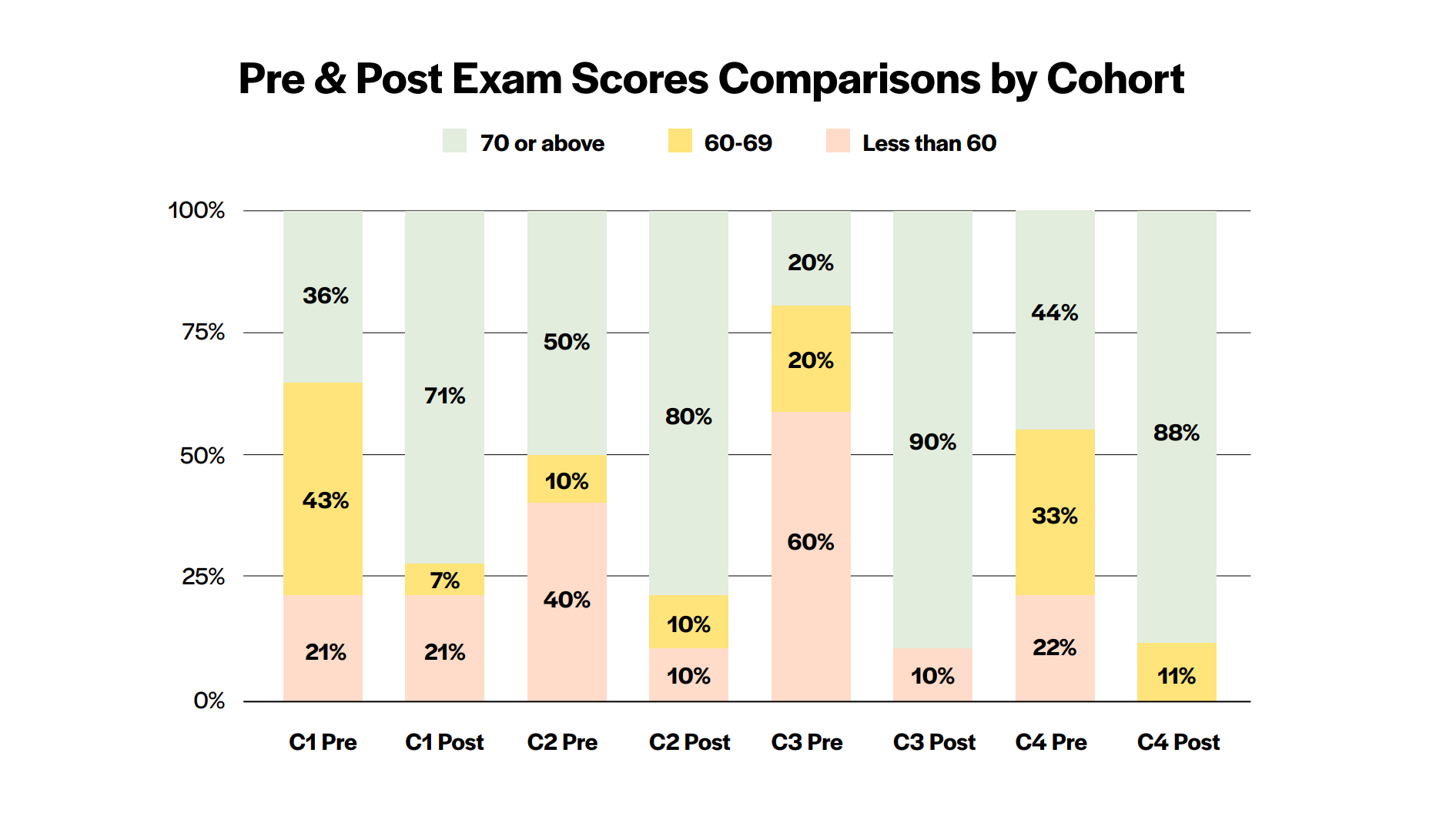
The results speak for themselves. Since launching the academies, TNTP and Austin ISD have supported 45 teachers on their path toward certification. With each cohort, participants have demonstrated increased growth between their diagnostic pre-assessments and post-assessments, showing that the model continues to improve over time.
The fourth Bilingual Academy cohort, for example, doubled the percentage of participants meeting the passing benchmark—from 44% on the pre-assessment to 88% on the post-assessment. At the same time, the percentage of teachers scoring below 60% dropped from 22% to 0%, demonstrating that every participant made meaningful growth.
That progress has translated into success on the official state certification exams. To date, 92% of Bilingual Academy participants have passed the Texas Bilingual Supplemental certification exam, exceeding the 2025 statewide pass rate of 77%. For teachers participating in the ESL Academy, the results have been equally remarkable: 100% have passed the ESL supplemental certification exam once the academy team has recommended taking the assessment.
“I scored a 75 (post-exam), which actually speaks volumes. I feel much better prepared, and my anxiety, in regard to the first test, has improved greatly,” said one academy participant
Just as important as the data is how teachers describe their experience. When asked whether they would recommend the academy to a colleague seeking certification, 98% selected the highest possible rating.
For teachers like Jenny, this work is about much more than passing a test.
It is about keeping excellent educators in classrooms where they are deeply needed. It is about recognizing teachers’ existing strengths while providing the support they deserve. And ultimately, it is about ensuring that emergent bilingual students have access to well-prepared, certified teachers who can help them thrive.
Every certification earned represents more than one teacher’s success—it represents hundreds of students who will benefit from stronger instruction throughout that teacher’s career.
The academy ended with a passing score for Jenny.
The next morning began where it mattered most: in her classroom.